When defense becomes much more than just tackling!
At around 12 years, kids start to find their place in big wide world for the first time in their lives, and this also has context for rugby: what is my role/place in the team? But as a coach, see it as an opportunity to practise this in a safe, rugby environment, how great is that!
So this blog post is typically aimed at players aged 9 to 11 years. However, consider your team’s development phase and some ideas presented here might apply.
Key characteristics of defense in this phase
Typically we can recognise this behavior when watching this age grade defend:
- Positioning: Focused on making individual tackles.
- Defense Alignment: Defenders position directly opposite attackers.
- Corner Flagging: Everyone runs to the corner flag.
- Defensive Line: Not yet self-evident.
So our main focus is developing a collective defense. While the attack is a mix of various plans, defense relies on a system with simple agreements. Your job is to clearly present these agreements to your team and provide matching exercises.
Learning Objectives
Lots of things to learn here:
- Tackling
- Distributing attention between the ball, teammates, and opponents
- Fighting for possession
- Controlling contact situations
- Collective movement (lateral and forward)
- Anticipating actions of teammates and opponents
- Aligning your tackle zone with others
Perhaps you are a bit overwhelmed, but hope you get some guidance reading this post! As usual I like the tactical approach to development, once you start with this tackle zone thing, relevant discussions and exercises will become more obvious.
Tackle & Tacklezone
The main objectives are:
- Moving up in defense, create your tackling zone, and making individual tackle
- Helping each other win the ball and attacking together
Realise each player just has to defend a specific area to make a tackle, we call this the tackle zone:

- Positioning directly opposite your attacker leaves you vulnerable. Instead, position in a way to limit the attacker’s options, focusing on left or right tackles.
- Using this positioning for all defenders integrates individual tackles into the system.
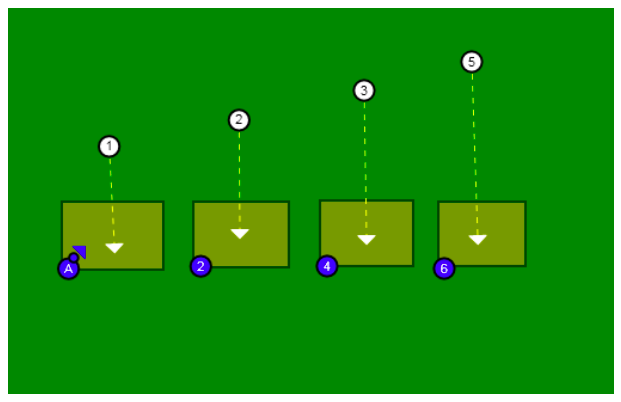
In the previous example, defenders tackle from left to right, “Inside” to “Outside”. How to support that development?
- Responsibilities: Each player is responsible for their own tackle area.
- Technique: Outside foot in front of the attacker, outside arm grabbing the attacker’s knee, outside shoulder planted, head on the inside.
Decision making
What are the decision we are asking our players to make? First, recognise you are the one who has to make that tackle and then create that tackle zone. Other players have to start working on aligning their tackle zones.
Setting up a defensive line: making the wall
Now learn the players to just align individual tackle zones in one defensive line (1st defensive line). Players must connect their tackle zone with fellow defenders.
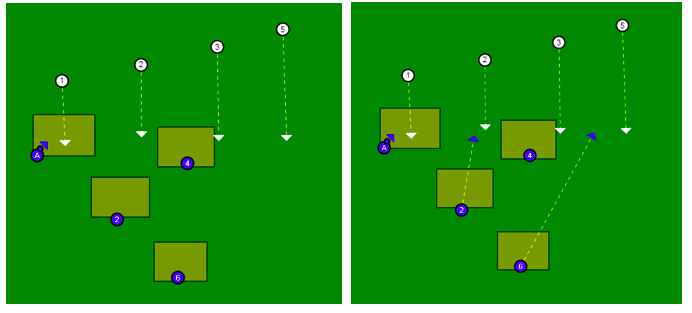
You can already do this during warm-up. For example I developed this “Make the Wall” exercise in SuperCoach Online: players dribble in a 10×10 square and on my signal run to one of the lines (I do East – West – North – South).
When we have organised this alignment, of course it is time to talk about the roles of the Designated Tackler and his Shadow Tackler, how we close the free space with line speed and drift in defense. So “Making the Wall” is a big big step forward indeed!
Coaching Role
Good to think about your ole as a coach in this development phase: it transitions from a more game master to that of a teacher:
- Children will explore their place within the group.
- Play remains crucial: it facilitates movement, reaction, problem-solving, and learning. No static drills!
- Transitioning from play to practice and back enhances learning.
- Practice rugby skills through play, but also through exercises to master techniques. Repetition is key.
- Train in clear subjects to maintain an overview.
- Encourage discovering solutions.
- Gradually increase difficulty as motor coordination develops.
- Provide a challenging, safe environment. Fun is essential!
- Remember: clearly define boundaries and do not tolerate disruptive behavior.
Related information
- Find a presentation on this for you to show to your team in the Download section;
- I posted earlier about how to set up a six week defensive training plan (for Under 16);
- SuperCoach Online is set up to support this structured approach through the age grades, this material is for example part of it;
What do you think about this approach? Shout-out to Sylvester who put me on this path and feel free to tweak it further! Subscribe and get notified when I add new posts to the Blog;