A great intervention!
I remember very well talking about the New Ball Feed with Paul and he questioned it, then saw it in action and his jaw literally dropped… He immediately recogised the power of this intervention!
The “New Ball feed” is an excellent action and an essential part of Pierre’s LPM philosophy. It is a specific coaching mechanism that helps develop open play by having the player experience how game continuity could develop. This is not just a “drill tip”; it is a Pedagogical Intervention designed to accelerate the transition from running and play getting stalled (note I am avoiding the word “Breakdown”) without forcing premature cognitive load (like tactical passing or complex breakdown strategies).
The Pedagogical Problem
At early age, Ball Carriers often hold the ball until stopped or tackled (“Bunch-up Rugby”) because they lack trust in support or fear making the wrong pass or simply are psychologically not yet ready to interact with teammates.
If us coaches force passing (“Pass now!” “Make a Line”), players develop “panic passing” into pressure, violating the core principle: “look for space to run into, keep the ball alive”, perhaps even stop scanning for space to keep the Go Forward momentum. But instead start focussing on ruck-to-ruck-to-ruck.
What happens: support players (FOLLOWERS / SATELLITES) remain passive observers of the LEADERS because the play effectively “dies” when the carrier is tackled. They still lack the trigger to become active. Suddenly the opportunity presents itself to involve the FOLLOWERS and SATELLITES.
The Mechanism: The New Ball Feed
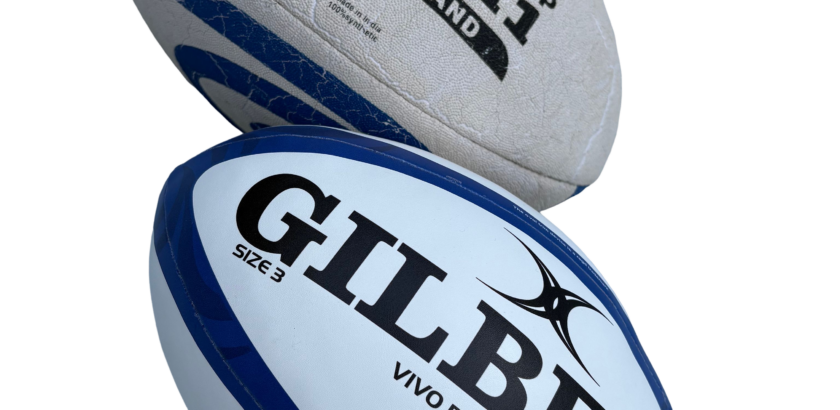
This is the coaching intervention where the trainer immediately introduces a second, new ball into the play the moment the primary Ball Carrier is tackled or forward momentum stops. Why does this work?
- Validates the Ball Carrier: The carrier is free to run hard into the space, evading defenders without the cognitive burden of “when to pass.” Now getting stopped or tackled is not a failure; it is just a transition point.
- Activates the Collective: The contact or tackle becomes the *trigger* for the support players. If they cannot yet keep the ball alive, we simply feed the New Ball. The arrival of the new ball forces FOLLOWERS and SATELLITES to instantly transition into LEADERS / Ball Carriers and experience how that feels. Remember players learn by doing?
- Creates Continuity: It simulates the “Recycle” phase before the players even have fully mastered the technical ruck, keeping the game flow alive and demanding constant spatial awareness.
Coaching Do’s and Don’ts
- DO feed the ball quick upon contact to maintain tempo. You DON’T have to wait for the tackled player to free the ball up or place the ball after the tackle or for it to die completely.
- DO take the opportunity and target your quietest players with the new ball. DON’T force the original ball carrier to pass “just to have him pass”.
- DO shout the name of the new carrier to reinforce leadership rotation or announce the new ball loudly. DON’T stop the drill to correct the ruck technique (keep the flow).
- DO use this to teach “Support Lines” by running into space yourself before feeding the new ball. I sometimes even block the first defender, showing that FOLLOWER the potential gap: “Ah, that’s how it looks / feels like”!
- DO use this too when there is a handling error. DON’T stop play for technical errors when everybody is in “tactical mode”.
Expected Outcomes
- Increased Ball Contacts: Every player touches the ball more often per minute. Not only LEADERS.
- Reduced Fear of Failure: Being tackled is no longer a “stoppage”; it’s a handover, I learned player very quickly focus on The New Ball.
- Emergence of New LEADERS: all are eased into decision-making roles repeatedly until it becomes habitual.
- Natural Passing: Once players trust that support is arriving (because the coach keeps the ball alive), they will naturally begin to pass *before* contact to maintain even greater speed.
- For older age groups, the New Ball Feed can for example work to act as a 10 getting the ball out of the Breakdown.
This approach is a repeatable coaching methodology that fits nicely within the LPM philosophy. It turns a “drill trick” into a developmental tool.
BEWARE: When? Who? Where? This is a skill you will have to develop and master as a coach! Try it, we learn by doing too!
Reference material
- More on that LEADER / FOLLOWER / SATELLITE thing in this post;
- My sum-up page of all blog posts Pierre Villepreux / LPM related;
And what did Paul do? He worked hard to implement this in his waterpolo coaching. Instead of standing on the side of the pool, was in the water and also tried feeding the new ball from the jumping board to be in the middle of it.
Subscribe and get notified when I add new posts to the Blog;